Mimikatz Cheatsheet
Windows - Mimikatz
Summary
Execute commands
Extract passwords
LSA Protection Workaround
Mini Dump
Pass The Hash
Golden ticket
Skeleton key
RDP Session Takeover
RDP Passwords
Credential Manager & DPAPI
Chrome Cookies & Credential
Task Scheduled credentials
Vault
Commands list
Powershell version
References
Execute commands
Only one command
Mimikatz console (multiple commands)
Extract passwords
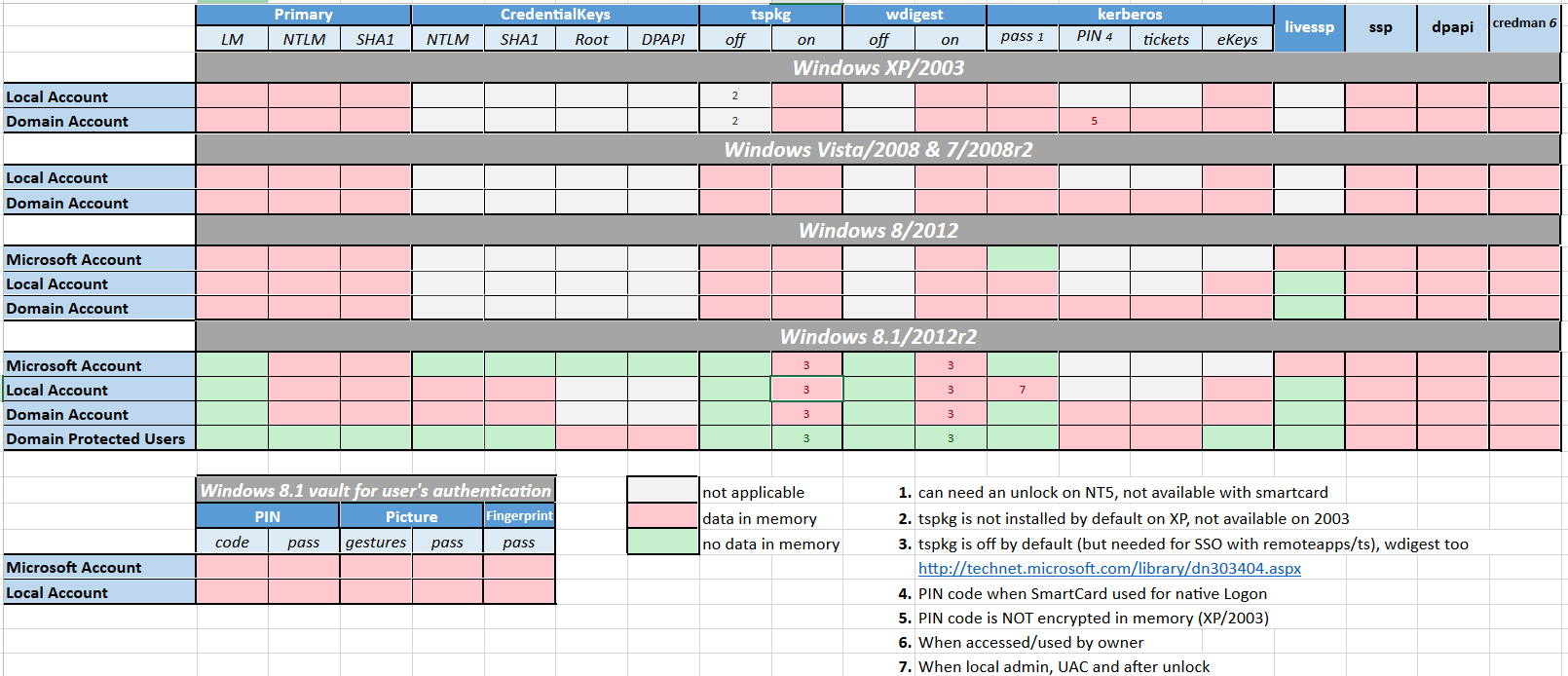
Microsoft disabled lsass clear text storage since Win8.1 / 2012R2+. It was backported (KB2871997) as a reg key on Win7 / 8 / 2008R2 / 2012 but clear text is still enabled.
⚠️ To take effect, conditions are required :
Win7 / 2008R2 / 8 / 2012 / 8.1 / 2012R2:
Adding requires lock
Removing requires signout
Win10:
Adding requires signout
Removing requires signout
Win2016:
Adding requires lock
Removing requires reboot
LSA Protection Workaround
LSA as a Protected Process (RunAsPPL)
LSA is running as virtualized process (LSAISO) by Credential Guard
Mini Dump
Dump the lsass process with procdump
Windows Defender is triggered when a memory dump of lsass is operated, quickly leading to the deletion of the dump. Using lsass's process identifier (pid) "bypasses" that.
Dump the lsass process with rundll32
Use the minidump:
Mimikatz:
.\mimikatz.exe "sekurlsa::minidump lsass.dmp"Pypykatz:
pypykatz lsa minidump lsass.dmp
Pass The Hash
Golden ticket
Skeleton key
RDP Session Takeover
Use ts::multirdp to patch the RDP service to allow more than two users.
Enable privileges
List RDP sessions
Hijack session
Run tscon.exe as the SYSTEM user, you can connect to any session without a password.
RDP Passwords
Verify if the service is running:
Extract passwords manually
Extract passwords using Mimikatz
Credential Manager & DPAPI
Chrome Cookies & Credential
Task Scheduled credentials
Vault
Commands list
CRYPTO::Certificates
list/export certificates
CRYPTO::Certificates
list/export certificates
KERBEROS::Golden
create golden/silver/trust tickets
KERBEROS::List
list all user tickets (TGT and TGS) in user memory. No special privileges required since it only displays the current user’s tickets.Similar to functionality of “klist”.
KERBEROS::PTT
pass the ticket. Typically used to inject a stolen or forged Kerberos ticket (golden/silver/trust).
LSADUMP::DCSync
ask a DC to synchronize an object (get password data for account). No need to run code on DC.
LSADUMP::LSA
Ask LSA Server to retrieve SAM/AD enterprise (normal, patch on the fly or inject). Use to dump all Active Directory domain credentials from a Domain Controller or lsass.dmp dump file. Also used to get specific account credential such as krbtgt with the parameter /name: “/name:krbtgt”
LSADUMP::SAM
get the SysKey to decrypt SAM entries (from registry or hive). The SAM option connects to the local Security Account Manager (SAM) database and dumps credentials for local accounts. This is used to dump all local credentials on a Windows computer.
LSADUMP::Trust
Ask LSA Server to retrieve Trust Auth Information (normal or patch on the fly). Dumps trust keys (passwords) for all associated trusts (domain/forest).
MISC::AddSid
Add to SIDHistory to user account. The first value is the target account and the second value is the account/group name(s) (or SID). Moved to SID:modify as of May 6th, 2016.
MISC::MemSSP
Inject a malicious Windows SSP to log locally authenticated credentials.
MISC::Skeleton
Inject Skeleton Key into LSASS process on Domain Controller. This enables all user authentication to the Skeleton Key patched DC to use a “master password” (aka Skeleton Keys) as well as their usual password.
PRIVILEGE::Debug
get debug rights (this or Local System rights is required for many Mimikatz commands).
SEKURLSA::Ekeys
list Kerberos encryption keys
SEKURLSA::Kerberos
List Kerberos credentials for all authenticated users (including services and computer account)
SEKURLSA::Krbtgt
get Domain Kerberos service account (KRBTGT)password data
SEKURLSA::LogonPasswords
lists all available provider credentials. This usually shows recently logged on user and computer credentials.
SEKURLSA::Pth
Pass- theHash and Over-Pass-the-Hash
SEKURLSA::Tickets
Lists all available Kerberos tickets for all recently authenticated users, including services running under the context of a user account and the local computer’s AD computer account. Unlike kerberos::list, sekurlsa uses memory reading and is not subject to key export restrictions. sekurlsa can access tickets of others sessions (users).
TOKEN::List
list all tokens of the system
TOKEN::Elevate
impersonate a token. Used to elevate permissions to SYSTEM (default) or find a domain admin token on the box
TOKEN::Elevate /domainadmin
impersonate a token with Domain Admin credentials.
Powershell version
Mimikatz in memory (no binary on disk) with :
Invoke-Mimikatz from PowerShellEmpire
Invoke-Mimikatz from PowerSploit
More information can be grabbed from the Memory with :
References
Last updated